Where do nuclear-powered ships stand?From technical potential to commercial operation
📅 Updated: 2026-10-10·⏱ About 10 min read·🏷 Nuclear ships / Nuclear / SMR
Nuclear power has decades of operating experience at sea. The challenge for next-generation merchant ships is to integrate reactors into ship designs, meet licensing and port-access requirements, and establish viable insurance arrangements and public trust. Drawing on the LR report, this article explains the benefits, limitations and next steps.
Image source: Lloyd’s Register, Fuel for Thought: Nuclear, p.9. Illustrative shipping photograph; it does not identify the vessel as nuclear-powered.
Contents
ONE-MINUTE BRIEF
Four conclusions first
Nuclear power has a record at sea. Next-generation merchant-ship concepts still need proof.
Naval and icebreaker experience shows that nuclear power can operate at sea. It does not replace the integration, licensing and operating evidence required for a civil merchant ship.
The attractions are long endurance, high energy density, and zero direct combustion emissions from the reactor.
That may reduce bunkering and change energy procurement and ship design. Lifecycle emissions, backup power and waste still have to be counted.
By 2026, progress has reached ship-type and port studies.
Concept approval, IMO regulatory work and route studies have all moved forward. Research, an Approval in Principle (AiP) and a formal operating licence are different stages.
What is worth tracking is evidence that the ship can be operated.
That includes demonstration in the marine environment, nuclear licensing, port access, insurance, fuel supply and decommissioning. No single technical milestone shows that commercial use is ready.
Drawn from the LR report, pp.5–9, 13–19 and 24–38. Recent developments are covered by the official sources in the next section.[1]
This note is for shipowners, seafarers, shipyards, surveyors and others in shipping. The aim is to understand the industry direction and to judge how far a development has gone. A claim made for one reactor design is not the performance of every nuclear ship.
02
Where do things stand?
Experience, concepts & current developments
There is still a distance between experience of nuclear power at sea and general use on merchant ships.
The LR report uses warships, Russian nuclear icebreakers, and historic ships such as Savannah and Otto Hahn to describe experience at sea. That experience matters. Government support, the mission, the reactor type and the liability arrangements all differ from those of an ordinary merchant ship. A next-generation merchant-ship concept needs its own safety and commercial evidence.[1 · pp.7, 15, 17]
Operating experienceDesign / researchRegulatory work
2026.02Concept approval
A hybrid nuclear preliminary design receives an AiP
The LR and Seatransport concept combines a micro modular reactor with a diesel-electric system. The sea-trial platform used to test the design assumptions is conventionally powered. This supports further development of the concept. It does not mean a reactor is already operating on board.[2]
2026.05Regulatory work
IMO approves a safety-regulation work plan that includes nuclear power
MSC 111 approved the SDC work plan, which covers nuclear power, wind and batteries, among other technologies. The plan published by SDC 12 aims to adopt a revised Nuclear Code and amendments to SOLAS Chapter VIII in 2030. That is a work schedule, not a rule already in force.[3][4]
2026.06Ship / port studies
Studies start to address ship arrangement and port-call conditions
LR and Korean industry partners studied an MSR auxiliary-power car-carrier concept, including shielding, cargo holds, stability and hazard identification. A separate desktop study, using Rotterdam as the case, assessed the regulatory, safety and liability arrangements a nuclear-powered feeder would need in order to call. A port study is not a deployment licence.[5][6]
2026.09Route study
Pink Corridor explores the conditions for a transatlantic nuclear container route
LR, Maersk and the ports of Charleston and Felixstowe are studying the security, safeguards, emergency response, insurance and regulatory requirements of a theoretical nuclear container route. It is a study of a specific route scenario. It does not mean an operating route exists, or that a fleet order has been placed.[7]
When you read the news, first ask which layer has been completed
Memorandum of cooperation → concept study → Approval in Principle (AiP) → detailed design and licensing by the competent authority → construction, testing and operation. Each layer needs different evidence. An AiP usually supports feasibility at the concept stage. Read its scope and conditions. It does not mean a nuclear operating licence, or port access, has been granted.
03
What are the benefits and trade-offs for shipping?
Benefits & trade-offs for shipping
The attraction is in the energy characteristics. The limits run through the whole life of the ship.
The points below turn the advantages and challenges in the LR report into practical questions a shipping reader can check. Potential benefits depend on the reactor, the ship type, the route and the regulatory conditions.[1 · pp.5–6, 10–19, 24–31]
Six benefits of a nuclear ship, and the limits that come with them
Aspect
Benefit / potential gain
Drawback / cost that must be managed
Emissions and environment
The reactor produces no combustion emissions in operation. It does not directly produce the CO₂, SOx, NOx and particulate matter that come from burning fuel.
Mining, enrichment, manufacturing, construction and decommissioning still have environmental effects. Spent fuel and radioactive material need long-term management. Diesel backup may also emit.
Endurance and bunkering
Refuelling cycles are measured in years. That can reduce frequent bunkering and dependence on fuel supply along the route, and improve long-term predictability of energy.
Refuelling or replacing a module is a specialist nuclear operation. It needs designated facilities, people and transport. Less bunkering is not the same as no maintenance.
Power and ship design
High energy density, and a continuous supply of energy. Worth studying for long voyages, high utilisation or high power demand.
Shielding, containment, heat removal, weight and segregated spaces have to be included. Cargo space and stability cannot be judged from the volume of the nuclear fuel alone.
Cost and business model
A long-term energy-service contract can be explored. The report describes a model in which a specialist holds and operates the reactor, and the owner pays for the energy delivered.
The cost of the first reactors, integration, licensing, insurance and decommissioning is still uncertain. Separating ownership of the equipment still requires a clear split of legal liability and performance risk.
Shore facilities and routes
Less need for day-to-day bunkering facilities. Not every voyage has to rely on tanks, bunker barges or a supply of alternative fuel.
A nuclear supply chain, specialist maintenance and waste facilities are still required. Port acceptance, cross-border licensing and emergency capability may limit which routes can be used.
Safety and people
Some advanced designs use passive safety. Natural circulation, material properties or other passive mechanisms can reduce the reliance of certain safety functions on external power and operator intervention.
Safety still has to be shown under ship motion, collision, fire, flooding and loss of heat removal. Security, safeguards, training and public trust cannot be left out.
ENVIRONMENT
Zero direct emissions ≠ zero lifecycle emissions
The report cites lifecycle studies of land-based nuclear power to illustrate the low-carbon potential. Land-based figures are not verified emission factors for every new marine reactor. A formal compliance calculation still follows the applicable regime and the approved method.
SAFETY
Passive safety ≠ no safety case
Different designs use different safety mechanisms. Decay-heat removal, containment and ship-accident conditions still have to be confirmed, together with workable emergency, security and staffing arrangements.
04
Five technology routes: start with the differences
Reactor technologies at a glance
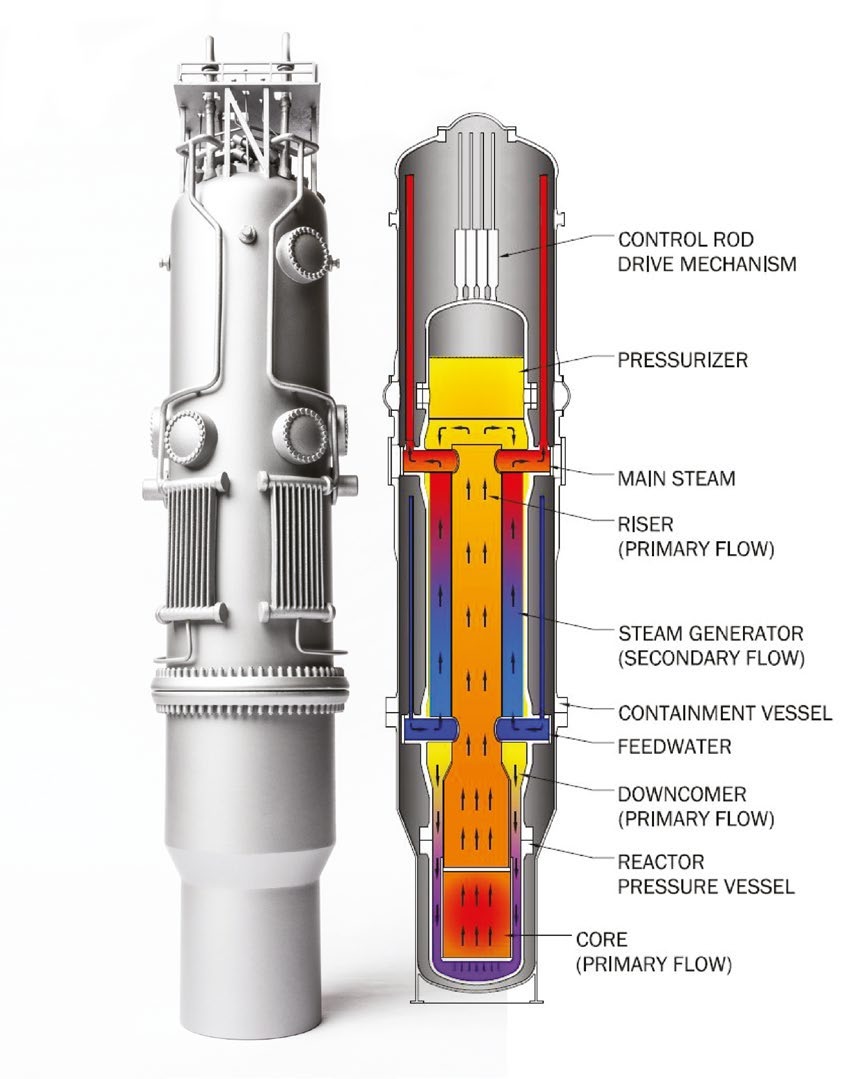
Nuclear power supplies heat, which is then turned into electricity, mechanical power or process heat. SMR (Small Modular Reactor) describes a direction toward small, modular designs. It is not one reactor principle. The LR report presents the five candidate technologies below. Their maturity, and what marine integration requires, are not the same.[1 · pp.32–37]
Five candidate reactor technologies and marine integration considerations, based on the LR report
Technology
Principle and attraction
Key considerations
Pressurised water, PWR
High-pressure water removes the heat. There is operating experience at sea. Smaller designs and passive safety are directions of development.
Existing naval experience does not prove that every civil SMR can be deployed. Marine integration and licensing are still required.
Heat-pipe microreactor, HPMR
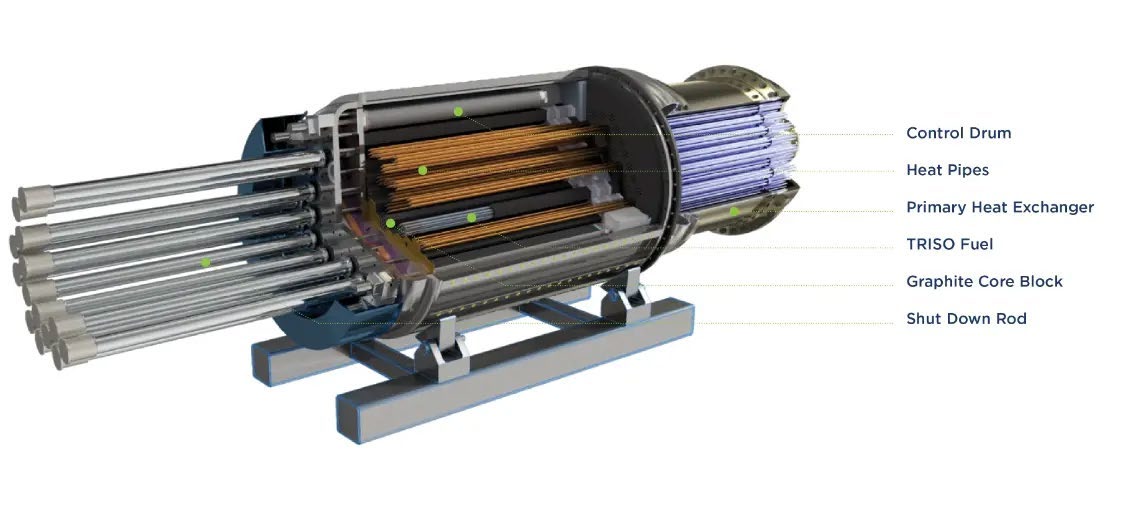
Heat pipes transfer the heat and reduce the need for pumped cooling circuits. Some concepts consider replacing the module as a whole.
Power, onboard integration, long-term performance, and the model for replacing modules and supplying fuel, still need to be shown.
Molten salt reactor, MSR
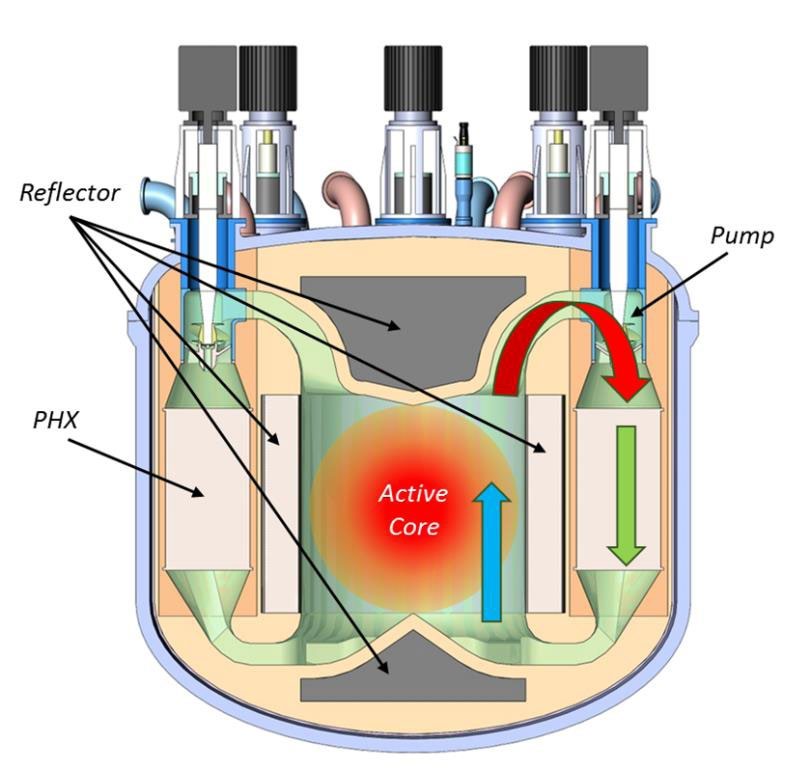
Molten salt carries the fuel and/or transfers the heat. Some designs feature low pressure and passive draining into a cooling tank.
Materials compatibility, corrosion, fuel fabrication and proof in the marine environment still matter. Fuel and safety design differ from one MSR to another.
Lead-cooled fast reactor, LFR
Liquid lead transfers the heat. Research directions include passive cooling and different ways of using the fuel.
Liquid-metal materials compatibility, weight, thermal management and maintenance have to be addressed. Historic lead-bismuth naval experience is not the operating record of every modern LFR.
High-temperature gas-cooled reactor, HTGR
Helium removes the heat. Ceramic-coated particle fuel is commonly used. The high-temperature heat can be studied for hydrogen production or industrial heat.
The report notes land-based operating experience, but marine application is still to be shown. Fuel production at scale, and marine integration, need a separate assessment.
The US Department of Energy and the Generation IV International Forum provide further explanations of these reactor technologies. Fuel, coolant, power output and safety mechanisms must still be assessed for each design.[9][10]
Use the report’s original figures to see the equipment concept
English labels and the original credits are kept. Select a figure to enlarge it. These are technical illustrations. They do not mean the equipment shown has a licence to operate on board.
PWR · Pressurised water
Source: Lloyd’s Register, Fuel for Thought: Nuclear, p.33.
MSR · Molten salt
Source: LR report, p.35. Original figure: TerraPower, molten chloride fast reactor.
Heat-pipe microreactor. Source: LR report, p.34. Original figure: Westinghouse’s eVinci™ Microreactor. Image courtesy of Westinghouse.Further reading: how does the LR report assess readiness?
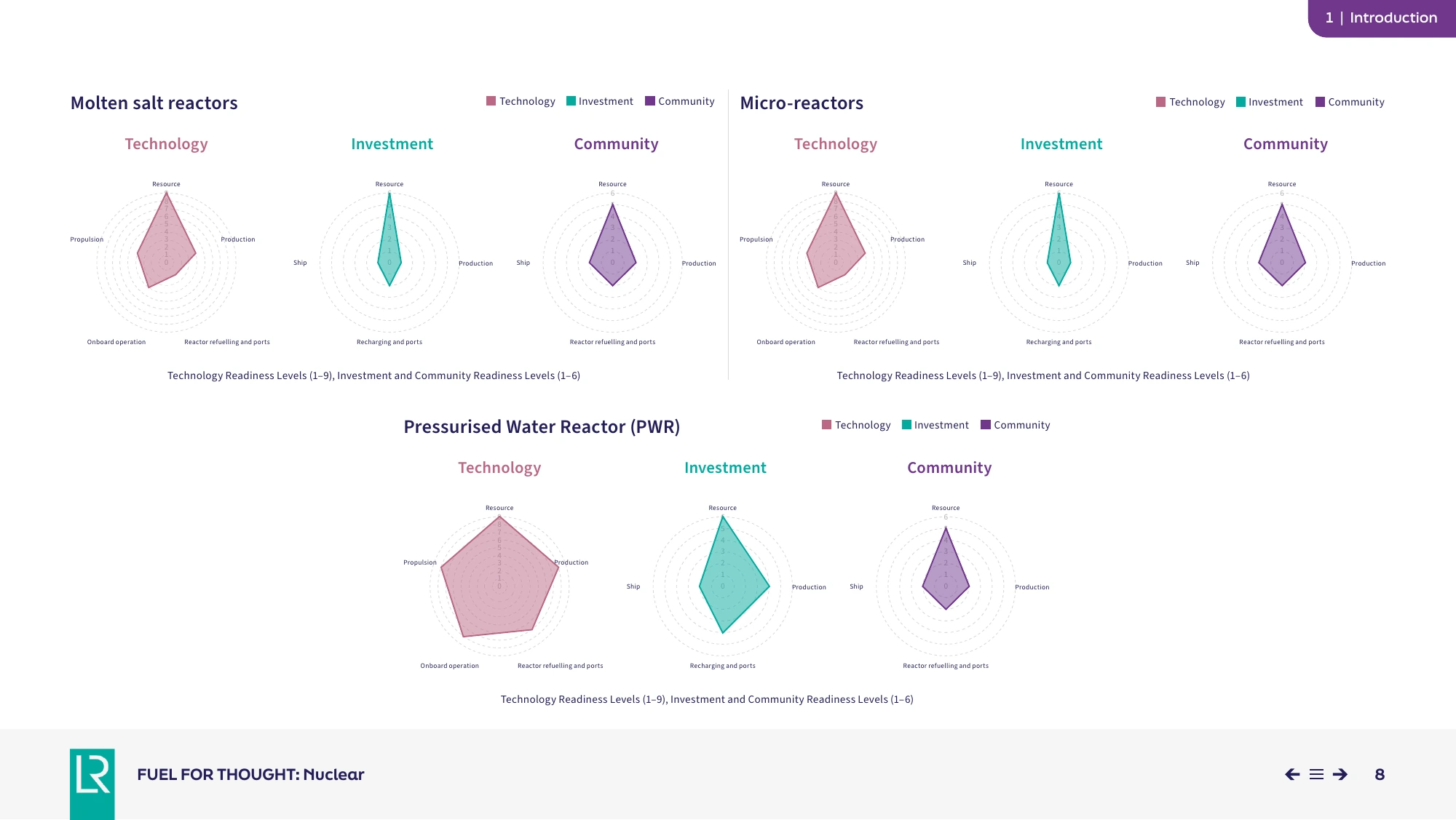
The report splits readiness into technology readiness, TRL (Technology Readiness Level, 1–9), investment readiness, IRL (Investment Readiness Level, 1–6), and community readiness, CRL (Community Readiness Level, 1–6). The three scales are different. Their areas cannot be compared directly, or added into one total score. Mature resources do not mean the ship and the port are ready to operate.
Source: LR, Fuel for Thought: Nuclear, p.8. Readiness assessment at the report’s reference date; scale definitions: pp.7 and 40–41.
05
What must be in place for commercial operation?
From a reactor to an operating ship
The merchant-ship challenge is to connect nuclear responsibility with the maritime system of responsibility.
SOLAS Chapter VIII and the 1981 Nuclear Code already provide a foundation. Advanced reactors, movement across borders and modern operating models need a new safety case and coordination between regulators. Class approval, flag requirements, the nuclear authority and port conditions each have to be confirmed.[1 · pp.13–19]
Safety case and nuclear licensing
Include ship motion, collision, grounding, fire, flooding, and loss of electrical power or of heat removal. Alongside Safety, Security and Safeguards also have to be addressed. Together they are the nuclear “3S”.
Port access and emergency response
A ship that can sail is not a ship every port will accept. Coordination between authorities, emergency zones, towage and salvage, and the ability to respond to an accident all affect whether a route can be used. The Rotterdam and Pink Corridor studies put these questions into specific operating scenarios.
Liability, insurance and finance
Nuclear liability may not simply follow the arrangements used for an ordinary ship. The liabilities of the owner, the reactor holder, the operator and third parties have to be confirmed, together with the insurance cover, limits and exclusions. Whether the risk can be insured directly affects whether the asset can be financed.
Fuel, specialist maintenance and decommissioning
Some candidate designs need HALEU, TRISO or another specific fuel. Having uranium resources is not the same as having qualified fuel that can be produced at scale. Refuelling, module transport, spent fuel and final decommissioning should be arranged early, in the commercial contract and in the project design.
People, governance and public trust
The competence of the crew and the shore team, licensed nuclear operation, accident reporting and safety culture need to be designed together. Trust in the port city, and in society, is also a condition of deployment. It should be built with evidence that can be checked, and with participation.
A DIFFERENT BUSINESS MODEL
Owners may in future buy an energy service
The report describes a possible model in which a specialist holds and operates the reactor, and the owner buys the output by the MWh. That may reduce the burden of the owner building a nuclear capability in-house. Cost and liability still appear through the contract, the price of the energy and the security for performance.
An economic assessment should compare the whole life: construction of the ship and the reactor, integration, licensing, operation, insurance, off-hire, refuelling and decommissioning. It should not only set the uranium price against the price of a tonne of fuel oil. The cost figures in the LR report are estimates for a specific scenario. They are not a price that can be used to place an order.[1 · pp.15, 26–31]
06
Future applications: onboard nuclear power and energy for shipping
Applications & milestones to watch
Nuclear power connects to shipping in more than one way. The LR report discusses both propulsion on board and floating nuclear plants that supply energy or make fuel. Different applications need different assessments of deployment, licensing and economics.[1 · pp.4–5, 32–38]
01
Onboard propulsion and shipboard power
Large ocean-going ships, high utilisation, or particular long-endurance tasks are scenarios worth studying. The reactor, the power system and the hull have to be designed together. It cannot be assumed that replacing the diesel engine is enough.
02
Floating nuclear power, and energy for ports and coasts
A floating nuclear plant can be studied for power supply, shore power or industrial energy. A facility that is fixed, or that moves only within limits, is not the same licensing case as a propulsion ship that calls frequently in other countries.
03
Using nuclear power to make low-carbon shipping fuels
Nuclear electricity or nuclear heat can be studied for hydrogen and synthetic fuels, so a conventional ship uses energy that nuclear power helped to produce. The final emissions still depend on the whole production and transport chain.
Track these five kinds of evidence, rather than guessing a year of widespread use
Five indicators for assessing commercial readiness; licensing requirements and timelines depend on the relevant authorities and project.
What to watch
What evidence would mean more?
Technical demonstration
Operating data relevant to the target design, testing in the marine environment, and verifiable validation of the safety systems.
Licensing and rules
A licence from the competent authority for a specific design and use, and formal adoption, entry into force and conditions of application of the revised rules.
A usable route
Access arrangements with named ports and coastal States, and workable coordination of emergency response, security and liability.
Insurable and financeable
Actual insurance terms, allocation of liability, capital commitments, and a lifecycle cost that can be checked.
Long-term operational support
A supply of qualified fuel, specialist maintenance, personnel qualifications, and funded arrangements for decommissioning and waste.
2030 is a work target, not a promise of widespread use
The report mentions an expectation of early deployment around 2030. The IMO work plan also targets adoption of the relevant amendments in 2030. The two do not mean the same thing. They cannot be combined into “nuclear merchant ships will be in general service in 2030”. Each project still depends on design, licensing, ports, the supply chain and investment.[1 · p.25][4]
For people in shipping at this stage, the most useful preparation is to understand the interface between the technology and the responsibilities, and to recognise the layer of progress described in official documents. When assessing a newbuilding or a route, compare nuclear power with the other energy options under the same mission, life and operating conditions.
07
Questions worth asking
Questions worth asking
Does a nuclear ship never need refuelling?
It depends on the design and the mission. The report discusses cycles from years to decades. Some concepts aim to cover the life of the ship. That is not a guarantee shared by every reactor. Maintenance, inspection and specialist services are still required.
Is every ship suitable?
No. Power demand, voyage length, utilisation, ports, shielding and weight, construction cost and the supply chain all affect whether it fits. Nuclear power is one route in the energy transition that is worth assessing.
Does passive safety mean no operators are needed?
That does not follow. Passive safety describes how a particular function is performed. It does not mean the whole ship can run without people managing it. Some designs propose remote monitoring. Watchkeeping, qualifications and emergency needs are still set by the specific design and by the licence conditions.
Can an existing ship be converted directly?
The report considers conversion unlikely in general. Only some high-value assets may be worth studying. Hull arrangement, shielding, thermal management, stability, licensing and remaining life may all make a newbuilding more suitable. Each case should be assessed on its own.
Do zero direct operating emissions automatically meet every decarbonisation rule?
Not necessarily. How the energy is counted, lifecycle factors, backup power and the compliance regime each have their own requirements. The report notes that, at the time, the treatment of nuclear power in some regimes still had gaps. A low-emission characteristic cannot be turned directly into a confirmed compliance allowance or a financial saving.
MARITIME PERSPECTIVE
The next step: from technical feasibility to commercial operation
Nuclear power will affect ship design, energy procurement, specialist personnel and shoreside governance. Alongside advances in reactor technology, meaningful progress includes operating arrangements that ports, regulators and insurers can apply across future projects.
08
Sources and the scope of this note
Sources, versions & further reading
Sources checked to 2026-10-10. This note is based mainly on the 42-page LR report, Fuel for Thought: Nuclear, with official updates added. It is not a complete list of every project worldwide, and it is not a safety approval of any particular design. Original figures keep their sources and the credits given in the report.
The main source is that report: applications and maturity, pp.4–9; safety, licensing and ports, pp.10–19; emissions and economics, pp.24–27; fuel and waste, pp.28–31; technologies, pp.32–37; readiness definitions, pp.40–41. The link is LR’s official entry point for the material.
26 February 2026. Approval in Principle for the Seatransport hybrid nuclear preliminary design and details of the conventionally powered sea-trial platform.
29 January 2026. The nuclear part sets a 2030 target for adopting a revised Nuclear Code and amendments to SOLAS Chapter VIII. For the later approval status, see [3].
11 June 2026. An early desktop study. The announcement states that it is not a licensing assessment, an endorsement of deployment, or a final safety or security case.
12 April 2021. Principles of advanced reactor systems, including molten salt and high-temperature gas-cooled designs. The deployment forecasts reflect the publication period rather than the industry’s position in 2026.
Technical information on lead-cooled fast reactors. Historic lead-bismuth-cooled submarine experience and modern LFR deployment conditions should be considered separately.
Data currency and applicability
This article reflects information reviewed up to 10 October 2026. Reactor costs, refuelling intervals and potential benefits at higher ship speeds depend on the design, vessel, route and operating conditions; they are not procurement quotations or performance guarantees. Regulatory adoption, entry into force and licensing conditions should be checked against the latest official announcements. For developments in the IMO Net-Zero Framework, see the official FAQ.[8]