Contents · jump by question
Read the wheel, and the evidence behind it.
- The wheel mark is the MED conformity mark.
It means the equipment has completed conformity assessment against the applicable EU marine equipment requirements, across life-saving, fire protection, navigation, radio and other categories. - The first part identifies the body; the second is the year.
In “2690/18”, 2690 is the notified body identification number, and 18 means the mark was affixed in 2018. - A mark is still not the whole answer.
Check the flag State’s requirements, the model, the scope of approval and the installation conditions before deciding that it suits this ship’s use. - The equipment, the declaration and the certificates have to match.
Read the physical label, the EU Declaration of Conformity and the relevant MED certificates together. That is what turns the mark into something you can trace.
Basis: MED Articles 3, 9, 10, 15 and 16; equipment categories are in the Annex to Regulation 2026/1434.[1][2]
A small mark, tied to conformity requirements
The meaning behind the mark
The wheel mark is the mark used under the EU Marine Equipment Directive to show that equipment meets the applicable requirements.
That directive is the Marine Equipment Directive (MED), 2014/90/EU. It builds on the relevant international conventions, performance requirements and testing standards, and sets out how conformity is assessed. Once the applicable procedure is complete, the manufacturer affixes the wheel mark as required.[1]
Why shipowners and crews need to recognise it
Purchasing has a basis
The order can state which approval and which documents are required, instead of buying on the product name or appearance alone.
Receipt can be checked
Use the model, the label and the documents to confirm that what was delivered is the product that was ordered and approved.
Checks can be traced
When something has to be verified or replaced, the matching declaration, certificates and conditions of use can still be found.
The MED applies to equipment to be placed, or already placed, on board an EU ship — a ship flying the flag of an EU Member State — where the international instruments require approval by the flag State administration. Where the equipment was made is not the only test. Whether a non-EU flag accepts or requires the MED still depends on that flag State.[1]
Recognising the mark is the start.
Its practical value is in connecting it to the right equipment and the right documents.The thread of this note · symbol, equipment, documents and use
Use a real label to read the wheel and the numbers
Read a real equipment label
Below is Hammar’s published product photo of the H20 hydrostatic release unit (HRU). The enlarged label shows the wheel mark and 2690/18.[3]
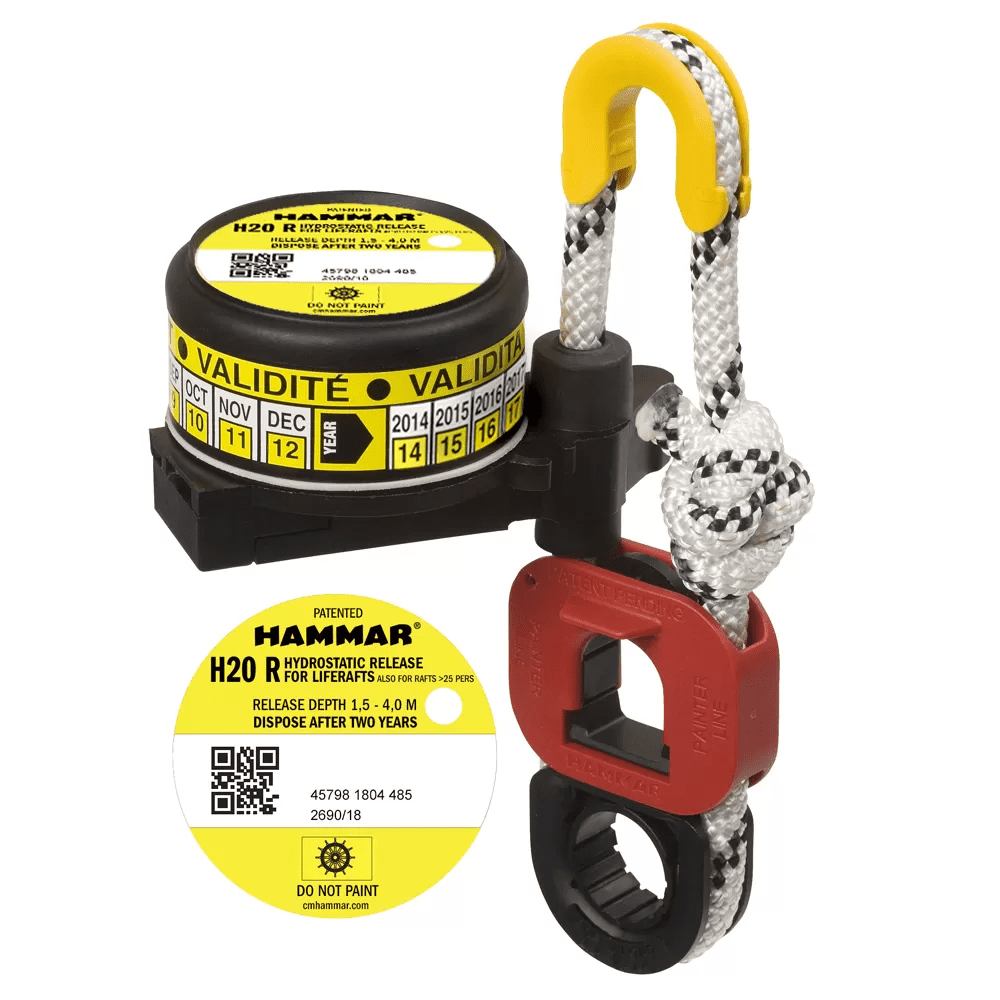
Three clues on the equipment
Wheel mark: the MED conformity mark.
2690: the notified body identification number.
18: the year of affixing, 2018 in this example.
The lower left is the maker’s enlarged view of the label. Select the photo to open the full original.
2690 → notified body identification number
It identifies the notified body involved in the production-control phase. It is not the serial number of this item, and it is not necessarily the same body as the one named on the type-examination certificate.
Who is the notified body?
Under the MED, a notified body is a body designated to carry out conformity-assessment tasks. Different bodies may be involved at different stages of the assessment.[1]
Keep the year separate from other dates
Article 10(3) of the MED refers to the year in which the mark is affixed. The date of manufacture, any expiry date and maintenance limits belong on their own labels and documents.[1]
Do not read the year after the wheel mark as the year the equipment must be scrapped, or as the certificate expiry date. That number alone does not tell you how long the equipment may still be used.
From life-saving gear to the bridge, where does it appear?
Equipment categories & examples
The wheel mark appears on many kinds of equipment related to ship safety. Four common categories are set out below, 27 examples in all, so the names can be connected to what is actually on board.[2]
Equipment that is on the MED list and within its scope of application must, in principle, complete the required conformity assessment and bear the mark. Conditions, exceptions and transitional arrangements for each item still have to be read in the official text.
The examples follow the Annex to Regulation 2026/1434. This is not a complete list. Each category can be opened or closed. The MED item numbers are there so the official entry can be found again.
LIFE-SAVINGLife-saving equipment8 examples
From personal protection to liferafts and release gear.
| Subcategory | Equipment | MED item |
|---|---|---|
| Personal life-saving | Lifebuoy | MED/1.1 |
| Personal life-saving | Lifejacket | MED/1.4 |
| Immersion protection | Immersion suit to be worn with a lifejacket: without / with inherent insulation | MED/1.5a, 1.5b |
| Distress rescue | Line-throwing appliance | MED/1.11 |
| Survival craft | Inflatable liferaft | MED/1.12 |
| Float-free | Liferaft hydrostatic release unit (HRU), such as the H20 in the photo above | MED/1.16 |
| Launching | Launching appliances using falls (davits) | MED/1.21 |
| Release gear | Release mechanism for lifeboats and rescue boats launched by falls | MED/1.26a |
Liferafts, davits and release mechanisms each have their own items. Approval of the main appliance does not automatically cover every fitting.
Official annex: life-saving equipment ↗FIRE PROTECTIONFire protection equipment7 examples
Fire extinguishers, and also personal protection and passive fire protection.
| Subcategory | Equipment | MED item |
|---|---|---|
| Fire-fighting | Portable fire extinguisher | MED/3.2 |
| Personal protection | Firefighter’s outfit: the close-proximity type specified in the list | MED/3.3a |
| Personal protection | Firefighter’s helmet | MED/3.6 |
| Respiratory protection | Self-contained compressed-air breathing apparatus (SCBA) | MED/3.7 |
| Escape equipment | Hood-type, open-circuit compressed-air emergency escape breathing device (EEBD) | MED/3.41b |
| Fire-resisting divisions | ‘A’ class divisions | MED/3.11a |
| Fire-resisting materials | Primary deck coverings | MED/3.1 |
The approved scope for fire divisions and materials can depend on the combination, thickness and method of installation. Check the configuration named in the certificate.
Official annex: fire protection equipment ↗RADIO COMMUNICATIONRadio equipment6 examples
Distress communication, safety-information reception and locating for rescue each have their own items.
| Subcategory | Equipment | MED item |
|---|---|---|
| Ship communication | VHF capable of digital selective calling (DSC) and radiotelephony | MED/5.1 |
| Long-range communication | MF/HF capable of DSC, narrow-band direct printing (NBDP) and radiotelephony | MED/5.14 |
| Safety information | NAVTEX receiver | MED/5.3 |
| Distress locating | 406 MHz emergency position-indicating radio beacon (EPIRB) | MED/5.6 |
| Survival craft | Portable two-way VHF radiotelephone for survival craft | MED/5.17 |
| Fire-fighting communication | Two-way radiotelephone for firefighters | MED/5.20 |
Radiotelephones for survival craft and for firefighters are separate items. An ordinary handheld radio is not a substitute.
Official annex: radio equipment ↗MED/1.16Equipment item numberUsed to look up the requirements for that kind of equipment.
2690Notified body identification numberPlaced next to the wheel mark, to identify the body.
The MED also covers other categories, including pollution prevention. A real product has to be checked by model, intended use, the version of the applicable standard and any transitional period. A generic product name is not enough.
Once you see the mark, which documents still matter?
The mark & its supporting documents
The wheel mark is a clue on the equipment. The documents tell you which product and which requirement that clue actually belongs to.
Start with the manufacturer, model and serial or batch number, then read the scope of the declaration and the certificates. Seeing the name of a certificate is not enough to confirm that the item in hand has completed every applicable procedure.
| What you check | What you need to confirm |
|---|---|
| Equipment labelMarking & identity | The wheel mark, the notified body number, the year of affixing, and identity data such as manufacturer, model and serial or batch number. |
| EU declaration of conformityEU Declaration of Conformity | Whether the product covered by the manufacturer’s declaration, the applicable requirements, the related approval information and the signature details match this item of equipment. |
| Relevant MED certificatesConformity assessment certificates | The scope of approval, the model, the assessment procedure used and any limitations. Where needed, check both the type-examination documents and those for the production phase. |
| Instructions for use and maintenanceMaker instructions | Whether the permitted use, installation, compatible components, inspection, maintenance and replacement conditions fit this ship’s arrangement. |
The table is a practical checking aid. The legal basis for MED conformity assessment and the declaration is Articles 15 and 16.[1]
A closer look: is a Module B certificate enough?
Where the route uses EU-type examination (Module B), it still has to be combined with the applicable production-quality assurance (D), product-quality assurance (E) or product verification (F). Unit verification (G) may be used for a single item or a small quantity. Which procedures are available depends on the equipment list, so a Module B certificate alone does not mean the whole MED procedure is complete.[1]
Article 16(4) of the MED requires that, when equipment is placed on board an EU ship, a copy of the EU declaration of conformity be provided to the ship and kept until that equipment is removed. That gives onboard checks a document they can trace back to.[4]
Where the mark is placed is also regulated. Where the nature of the product makes it impossible or not warranted to affix the mark on the product or its data plate, Article 10(1) requires it on the packaging and the accompanying documents. If the mark is not visible on the item, check the applicable rule and the documents before drawing a conclusion.[1]
Turn recognition of the mark into three checks
Procurement · Delivery · On board
The following is practical guidance for ship and shore. Checking the equipment, the documents and the intended use together is what makes the wheel mark useful in purchasing and day-to-day management.
Before purchase, write down the approval and the documents to be delivered
Confirm the flag, the intended use and the applicable equipment item. Ask the supplier for the MED approval information, the EU DoC and the instructions for the correct model, and confirm that any alternative model or fitting is still inside the approved scope.
Suggested output · a clear equipment specification and a list of documents to be deliveredOn receipt, match the physical label to the documents
Check the manufacturer, model, identity data and the mark. Record the year of affixing separately from any service-life limit. If the label and the documents do not agree, clarify that with the supplier or the relevant party before deciding whether the item can be accepted and put into use.
Suggested output · a receipt check record and the documents for that itemOn board, keep confirming condition and conditions of use
Keep the declaration and certificates where they can be found, and maintain the equipment according to the maker’s instructions and the applicable requirements. If a component is replaced, or the installation or the use changes, check the approved scope and the ship’s acceptance conditions again.
Suggested output · documents and maintenance records that still lead back to the item
One point each for ship and shore
Owner / manager
Keep the specification and the purchasing requirements clear, and make sure the delivered documents are complete and can be found from ship and shore.
Crew
Be able to read the label, find the matching documents, and know the conditions of use and maintenance.
Other maritime practitioners
Check that the item, the documents and the intended use agree, and confirm acceptance conditions with the flag State or RO when that is needed.
A wheel mark does not remove the need to look for damage, failure, expiry or incorrect installation. The mark speaks to conformity. Whether the item may continue in use still depends on its condition and the applicable requirements.
Four questions that are easy to mix up
Common questions
Does a wheel mark mean any ship can use the equipment as it is?
The flag State’s requirements, the intended use, the model and the installation conditions still have to be confirmed. The MED has its own legal scope. Whether a non-EU flag accepts a particular MED item depends on that flag’s requirements.[1]
Is the wheel mark a certificate issued by IMO itself?
The wheel mark is a conformity mark under the EU MED regime. The relevant international conventions, performance requirements and test standards are the basis of the assessment. The assessment is carried out by a notified body designated under that regime. The mark should not be described as a certificate issued by IMO itself.[1]
Does a CE mark mean the equipment already meets the MED?
No. A CE mark alone does not establish MED conformity. Marine equipment within the scope of the MED has to be checked against that regime’s conformity assessment and wheel-mark requirements.[1]
Are the year of affixing, the date of manufacture and the expiry date the same thing?
No. They mean different things. The year after the wheel mark is the year the mark was affixed. The date of manufacture and any limit on how long the equipment may be used have to be taken from the relevant marking and the maker’s documents. The period of validity of a certificate is a separate check.[1]
Let a small mark lead back to a complete set of equipment records.
For an owner or a member of the crew, the value of recognising the wheel mark is being able to ask the right questions from the symbol. What equipment is this? Which model? Do the documents match? Is it suitable for this ship’s use? When those questions have a basis, the mark becomes a help in managing the ship.
Sources and the scope of this note
Sources & editorial notes
Sources checked on 2026-10-05. This note focuses on recognising the mark and on basic checks. Legal explanation and practical guidance are kept separate, and each equipment example keeps an item number that can be looked up.
- EUR-Lex · Directive 2014/90/EU ↗
The EU Marine Equipment Directive. Article 3: scope. Articles 9 and 10: the wheel mark and affixing. Articles 15 and 16 and Annex II: assessment procedures and the EU declaration of conformity. Annex I: the form of the mark. The page can be followed through to the current consolidated text.
- EUR-Lex · Implementing Regulation (EU) 2026/1434 ↗
In force on 2026-08-31. The 27 examples and MED item numbers in this note are taken from categories 1, 3, 4 and 5 of the Annex. Test versions, limits on use and transitional periods have to be read in the matching row.
- CM Hammar AB · HR-0100 official product page ↗
Maker product photo and enlarged label for the H20 hydrostatic release unit. Used here to show how to read the wheel mark and “2690/18”. The photo is unchanged apart from display scale. © CM Hammar AB.
- Norwegian Maritime Authority · requirements for declarations of conformity for marine equipment ↗
Cites MED Article 16(4) on keeping a copy of the corresponding EU DoC on board.
- EMSA · Marine Equipment ↗
The European Maritime Safety Agency’s explanation of marine equipment, and the entry point for the MED Portal.
Scope of this note: an introduction, for shipowners, crews and other maritime practitioners, to recognising the mark and checking documents. It does not list every MED item, and it does not decide the certificate, test version or transitional arrangement for any particular product. Actual application depends on the latest official text, the flag State or RO, and the arrangement on the ship.