New Construction Project Management
Six-Step Visual Note
This note organizes a new construction project into six practical steps for project managers and marine surveyors: project initiation, pre-site preparation, transition and review, initial site construction, ongoing survey, and delivery close-out. The point is not to memorize document references, but to understand the responsibility, inputs, key outputs, and risk controls at each stage.
Scope / Status / Stakeholders
Safe & Timely Delivery
01 · Scope and Purpose
What does this process manage?
This note is written for new construction project management. The PM's job is to make sure deliverables are completed correctly and on time while keeping control of service scope, resources, document status, site survey progress, and delivery risk.
Typical scope of a new construction project
Three management axes for the PM
02 · Six-Step Project Flow
Overview of the six project steps
The process can be understood as six stages. Each stage should have clear ownership, input information, meeting records, status tracking, and delivery outputs.
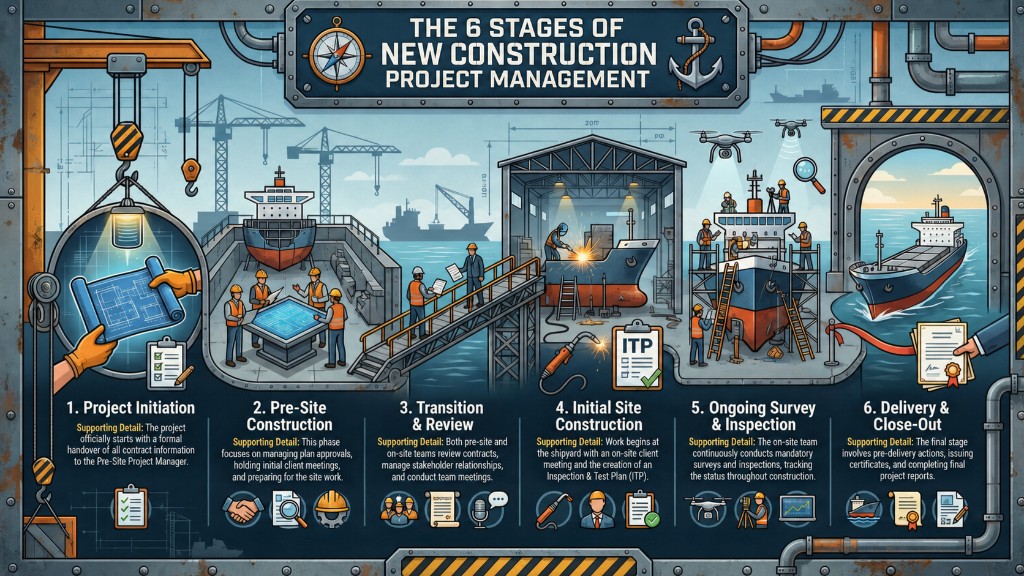
Project Initiation
Transfer contract and project information; establish baseline data.
Pre-Site Construction
Prepare drawings, documents, meetings, and pre-site coordination.
Transition & Review
Transfer from pre-site to site and review contract and status again.
Initial Site Construction
Hold the site kick-off meeting and establish the inspection plan.
Ongoing Survey & Inspection
Continue inspection, status updates, and issue tracking.
Delivery & Close-Out
Prepare delivery, certificates, feedback, and close-out reporting.
03 · Key Roles
Four key roles
Business / Client-Facing Manager
Collects the contract, quotation, scope, and client information after the project is awarded, then hands complete information to the pre-site project manager.
Pre-Site Project Manager
Manages the pre-site phase, especially drawing review assignment, status lists, initial client meetings, and document completeness before site handover.
Site Project Manager
Manages the site construction phase, including inspection scope, inspection plan, site communication, certificate delivery, and close-out obligations.
Technical / Line Support
Ensures plan approval and site resources are available, and supports escalation when resources, scope changes, major risks, or deviations need management attention.
04 · Six Steps in Detail
Detailed view of the six steps
The following cards use a simple "purpose -> key work -> outputs" structure so a PM can check the project stage by stage.
Project Initiation
Once the contract or service scope is confirmed, the project handover process should formally begin. The project manager needs a clear view of ship type, construction scope, client requirements, flag requirements, quotation basis, and potential risks.
Pre-Site Construction
The pre-site phase focuses on drawing and manual submission, design information, the initial client meeting, stakeholder contacts, and the pre-site working rhythm. The clearer this phase is, the easier site execution becomes.
Transition & Review
When the project moves from pre-site to site, the team should review the contract, drawing status, open items, site resources, yard schedule, and responsibility split again. The same check should happen when a PM handover occurs.
Initial Site Construction
When site work starts, the team should hold an initial site meeting and establish the communication protocol. HSE, subcontractors, patrol approach, drawing control, inspection plan, document submission, and open item handling should all be confirmed.
Ongoing Survey & Inspection
The site team performs surveys according to approved drawings, the inspection scope, and the inspection plan, while updating completion status and open items. Repeated re-inspections, missing information, or delivery-impacting issues should be escalated early.
Delivery & Close-Out
Before delivery, certificate preparation, document review, payment or contractual conditions, and final open item clearance should be handled early. After delivery, the team should capture client feedback, effort variance, service performance, and lessons learned.
05 · Practical PM Checklist
Documents and status items a PM should maintain
📁 Project File
- Contract, quotation, and payment terms
- Flag, regulatory, and class requirements
- Organization chart and contact points
📐 Drawing / Document Review
- Drawing and manual review assignment
- Review status and rejection reasons
- Open review comments
🔍 Inspection Plan
- Site inspection scope
- Hold / witness / review points
- Completed and outstanding inspection status
🧾 Certificates
- Draft certificate preparation
- Review by authorized personnel
- Payment and delivery condition confirmation
📊 Resources
- Monthly effort against forecast
- Out-of-scope work records
- Variance explanation and corrective actions
🗣 Feedback
- Client service evaluation
- Close-out meeting feedback
- Lessons learned and improvement items
06 · Deep Dives
Three management points that most affect delivery
1. Inspection Plan: turn "what to inspect" into trackable status
What
The inspection scope may cover hull, machinery, electrical / control systems, statutory surveys, tank tests, non-destructive examination (NDE), commissioning, and sea trials.
How
If the shipyard's inspection plan is not clear enough, the site team should create a trackable version and confirm it with the yard and project team.
PM focus
The inspection plan and open items must be trackable, backed up, and available to the client. The key is to avoid unresolved items that block certificate issuance before delivery.
2. Drawing Review: if drawing status is not synchronized, the site loses its basis for judgment
What
The pre-site lead should identify all documents requiring review, assign review responsibility, and make sure the site team can see the latest status.
How
The review status list should be maintained continuously and shared in a format and frequency agreed with the site team, so the site can confirm that it is using current and applicable drawings.
PM focus
If the submission is incomplete, outside the agreed scope, or requires additional work, the PM should discuss it with the relevant managers early rather than leaving the site team to absorb the delay.
3. Certificates & Close-Out: delivery does not start on the final day
What
Before delivery, draft certificates, internal review, requirement checks, and necessary copies should be prepared in advance.
How
Leave time before the delivery date to check payment and contractual conditions, so certificates are not ready while delivery conditions remain unclear.
PM focus
Close-out should look at three things together: whether delivery was on time, whether the client was satisfied, and whether the team delivered within the expected budget and resource envelope.
07 · Risk Signals
Signals that should trigger PM escalation
08 · Meeting and Quality Plan
Topics for client meetings and quality planning
These topics can be used to prepare for the initial meeting, progress meetings, or internal team meetings.
Suggested initial meeting topics
Quality and inspection management topics
09 · Quick Reference
Forms and records quick reference
| Document / Record | Purpose | Main timing |
|---|---|---|
| Project Handover Checklist | Confirms contract, scope, quotation, risks, payment, flag requirements, and current project status. | Project initiation, PM change, pre-site to site handover |
| Team Handover Report | Explains ongoing work, expected work, open items, and major issues. | Leave, reassignment, or substitute personnel handover |
| Project Quality Plan | Describes the quality framework for service scope, material / equipment certification, inspection, NDE, patrols, and tests. | Initial meeting, quality management, client explanation |
| Meeting Checklist | Prepares and records meeting time, attendees, topics, actions, and responsible persons. | Pre-site and initial site meetings |
| Service Evaluation Form | Collects client ratings and feedback on the team, plan approval, site service, and overall support. | Mid-project or before / after close-out |
| Relationship Checklist | Checks stakeholder map, decision process, variation / dispute handling, and formal communication. | Relationship management or rising client communication risk |
| Project Completion Report | Summarizes resources, financials, client satisfaction, service delivery, team learning, and improvement suggestions. | After certificate delivery and internal close-out meeting |
Note: This page is reorganized for learning and review. It does not replace formal procedures, rules, contracts, flag requirements, or the latest internal company guidance.