Contents
ONE-MINUTE BRIEF
Four conclusions to start with
- Consider human capability and limitations at the design stage. Whether operation is easy to understand, whether maintenance can be done safely, and whether people can act in an emergency all affect safety.
- Risk models need to be calibrated with evidence over time. Measured ammonia releases, leak-frequency research and onboard experience can gradually improve how credible an assessment is.
- A safe haven has to be integrated with the ship-wide emergency response. A protected space is only useful if people can reach it, stay protected, and maintain essential command and communication functions.
- Training has to match the actual work. Fuel systems, maintenance, leaks and ship–shore coordination each need clear roles, competence and a way to verify them.
How new fuels change the demands on personnel
PEOPLE & NEW FUELS
Once a ship uses an alternative fuel, the combination of hazards and the way systems behave may change. Toxicity, flammability, low temperature and failure modes differ by fuel. Experience with conventional fuel oil has to be reviewed against the new system.
After an abnormal condition is detected, for example, people need to know what an alarm means, which actions the system has already taken, and how they should respond next. If information is scattered, the control interface is hard to understand, or safe operation depends on a person completing several steps in a row under pressure, carrying it out can become difficult.
Pages 9–10 of Impact Report: Year Six describe the problem as a possible gap between the characteristics of the new system and the capabilities people already have. Design and personnel readiness therefore need to move forward together. The examples below are drawn mainly from ammonia-fuel work. They should not be treated as one set of requirements that methanol, hydrogen or other fuels share.
Use human factors to reduce operating difficulty
HUMAN FACTORS
Human factors is about how people, equipment, work and the environment affect one another. It asks the design team to understand what the person using the system can see, understand and do under real working conditions.
The annual report records that, in work with AET, DSIC and WinGD, the Decarb Hub brought a human-factors assessment into an ammonia-fuelled ship design that was already under way. The significance is that operating needs had a chance to influence the design early. The report does not publish a list of drawing changes or a quantified reduction in incidents, so it cannot be inferred that any particular arrangement has been fully verified.
A project team can turn human-factors issues into specific review questions. The table below is a set of practical questions arranged from those principles. It is not a list of changes actually made in that case, and it is not an additional statutory checklist.
| Review aspect | Questions to ask | Evidence worth keeping |
|---|---|---|
| Review aspectAlarms and information | Questions to askCan people identify where the abnormality is, how serious it is, and the system state? | Evidence worth keepingScenario walkthroughs, and records of alarm and control-interface reviews |
| Review aspectOperation and isolation | Questions to askCan personnel safely reach and correctly identify the controls needed for the task? | Evidence worth keepingArrangement review, task analysis and an operating demonstration |
| Review aspectMaintenance and protection | Questions to askWearing the required protective equipment, can people complete the intended work? | Evidence worth keepingMaintenance-access review and verification of the work steps |
| Review aspectEscape and protection | Questions to askDoes the assessment of access to protected spaces account for different work locations, physical conditions and levels of mobility? | Evidence worth keepingScenario analysis, route review and feedback from drills |
The earlier these questions are raised, the more chance the team has to deal with them by adjusting arrangement, interfaces or working methods. Procedures, training and protective equipment still matter, and they need to form a consistent safety arrangement with the design.
The credibility of a risk assessment comes from the evidence behind it
RISK & EVIDENCE
A risk assessment has to answer two kinds of question: how often an event may occur, and what the consequences would be if it did. New fuels have a limited operating history on ships, so some frequencies or model parameters still need research to support them.
ARISE and SAFEN, as described in the report, strengthen that foundation from different directions.
ARISE looks at how ammonia actually behaves after a release. The report says a controlled low-temperature ammonia release trial at sea was completed in June 2026. The related work also covers detection in air and water, and the interaction between ammonia and seawater. Measured data can be used to test the assumptions in dispersion and consequence models. Completing the trial does not mean that every model and every situation it might be applied to has been verified.
SAFEN looks at methods for estimating the frequency of loss of containment (LoC). Besides component failure, the research also considers how operations, human factors and management practice affect an event. The annual report records a phase-two application case for an ammonia-fuelled ship, and says the work will continue to be developed toward use in actual risk assessments.
This work reminds a project team to read an assessment result together with its data sources, assumptions, conditions of application and uncertainty. A single conclusion in the report cannot replace design and operational analysis for the individual ship. (Annual report, pp. 11–13.)
How a safe haven protects people on board
SAFE HAVEN
An ammonia-release scenario raises a direct question: if part of the ship may be affected, where can people go to be protected?
A safe haven is a protected space arranged as refuge during an ammonia release. Section 12bis.5 of the IMO Interim Guidelines for the Safety of Ships Using Ammonia as Fuel, MSC.1/Circ.1687, sets out refuge in one or more enclosed spaces, with a total capacity covering all persons on board. Where necessary, safe havens should also be provided at locations essential to the ship’s operation. The design should reduce the risk of ammonia exposure. Ventilation arrangements or a self-sustaining air supply for the refuge space are measures the guidelines list. The document is interim guidance. Applicability and the specific conditions of acceptance have to be confirmed for the ship and with the Administration. That edition of the guidelines does not address ships using ammonia cargo as fuel. The guidelines also exclude ships covered by the IGC Code. IMO text, 2025-02-26
The Decarb Hub’s Safe Havens study organises the problem into four connected aspects:
| Aspect | Questions design and operation need to resolve |
|---|---|
| AspectScenario definition | Questions design and operation need to resolveWhich release scenarios and adverse conditions must the protection arrangements cover? |
| AspectProtective capability | Questions design and operation need to resolveHow long does protection need to last, and how is it shown to be effective? |
| AspectCommand and control | Questions design and operation need to resolveOnce people are inside, how do they keep track of the situation and work with the ship-wide emergency response? |
| AspectAccessibility | Questions design and operation need to resolveHow do people reach, enter and leave, and have the needs of injured people been considered? |
This way of thinking connects the refuge space back to the ship-wide emergency response. Location, access routes, protective capability and the operations that are still required need to be assessed together. The study also emphasises verification and maintenance throughout the vessel’s service life to ensure that the safe haven continues to provide the intended protection. Safe Havens study brief, 2026-07-28
The required duration of protection, ventilation rate and allowable exposure concentration should be determined from the applicable requirements, scenario analysis and the specific design basis.
Competence has to match the actual situation
COMPETENCY & TRAINING
Personnel readiness has to cover routine operation, and also abnormal situations that may be infrequent but serious in consequence. The competence question can be concrete: can a person explain the system state, recognise their own authority and responsibility, and complete the tasks required of them in the agreed response arrangements?
IMO has confirmed that MSC 111, in May 2026, approved two sets of interim training guidance: STCW.7/Circ.26 for seafarers on ships using methyl/ethyl alcohol, and STCW.7/Circ.27 for seafarers on ships using ammonia as fuel. That means there is now further international guidance on fuel-specific competence. It should not be read as meaning that a fully harmonised new certification regime has already been adopted worldwide. IMO training update, 2026-08-11
The annual report also discusses readiness of people on board and ashore. Seafarers, technical superintendents, maintenance contractors and the relevant shore teams should build their way of working together around their own tasks and risks. That does not mean every role is covered by the same seafarer certificate or training requirement.
In practice, familiarity with the fuel system, maintenance isolation, leak scenarios and emergency reporting can each be set out as who is responsible, what competence is needed, and how it is verified. If a drill shows that information or equipment is hard to use, that finding should be taken back into the review of design, procedures and training.
Document safety readiness with verifiable evidence
READINESS & VERIFICATION
Whether safety readiness is in place depends on whether design, risk, procedures and competence correspond to one another. What follows is a way of organising project work. It is not an operating procedure for use during an incident.
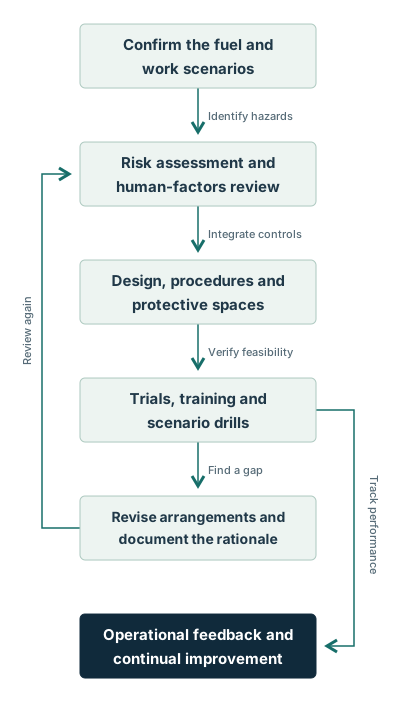
Shipowners and project teams can retain several types of records and supporting evidence: a list of scenarios and assumptions, design-review comments and how they were handled, the basis on which protective measures were verified, operating and response procedures, and competence-verification records for the roles concerned. Their purpose is to let later readers understand why the safety arrangements hold, and which changes in conditions call for a new assessment.
Questions
QUESTIONS & ANSWERS
If the design meets the rules, why is a human-factors review still needed?
Rules and approval are an important basis for the design. A human-factors review goes on to examine whether users can understand and operate the system under the specific working conditions, so that the design intent can be carried out in the actual work.
Does having a safe haven mean the ammonia-leak risk has been dealt with?
The release scenarios, whether people can reach the space, the protective capability, and the link to the ship-wide emergency response still have to be assessed. A refuge space is one part of the protection arrangements. It cannot replace leak prevention, detection, control and the other measures that are needed.
Does completed research mean it can be applied directly to every ship?
Research supplies evidence within a particular scope. Applying it still means confirming the ship type, system, environment and operating conditions, and keeping the limits of the data or method in view.
A practical note: bring people’s needs into the design
PRACTICAL PERSPECTIVE
Safety readiness for an alternative-fuel ship is worth examining by asking whether the arrangement can actually be used in a real situation. When the needs of operation, maintenance and emergency response are seen early, the project team has a chance to deal with difficulties before delivery, and later training can be built on a system that can be operated.
Each scenario walkthrough and drill should also become feedback for improving the design and the working methods. Experience accumulated that way is what can gradually strengthen the safety evidence the next generation of ships will need.
Sources and scope
SOURCES & SCOPE
- Lloyd’s Register Maritime Decarbonisation Hub, Impact Report: Year Six, covering July 2025 to June 2026; relevant material is on pp. 9–13 and 23. This is an impact report of the organisation and its partners, not a safety approval for an individual ship.
- IMO, MSC.1/Circ.1687, 2025-02-26; interim guidelines for the safety of ships using ammonia as fuel. Safe-haven arrangements are in section 12bis.5. Confirm the scope of application when using them.
- The Decarb Hub, Safe Havens for ammonia-fuelled ships, 2026-07-28; explains safe havens through scenario, protection, command and control, and accessibility.
- IMO, Preparing seafarers in the Caribbean for the fuel transition, 2026-08-11; describes approval of the interim training guidance for seafarers on methyl/ethyl alcohol and ammonia fuels, and training practice.
This article organises published research and guidance. The practical questions and the workflow are an interpretation and suggestions for preparation. Design, operation and approval for an individual ship should follow the applicable requirements and a dedicated assessment.